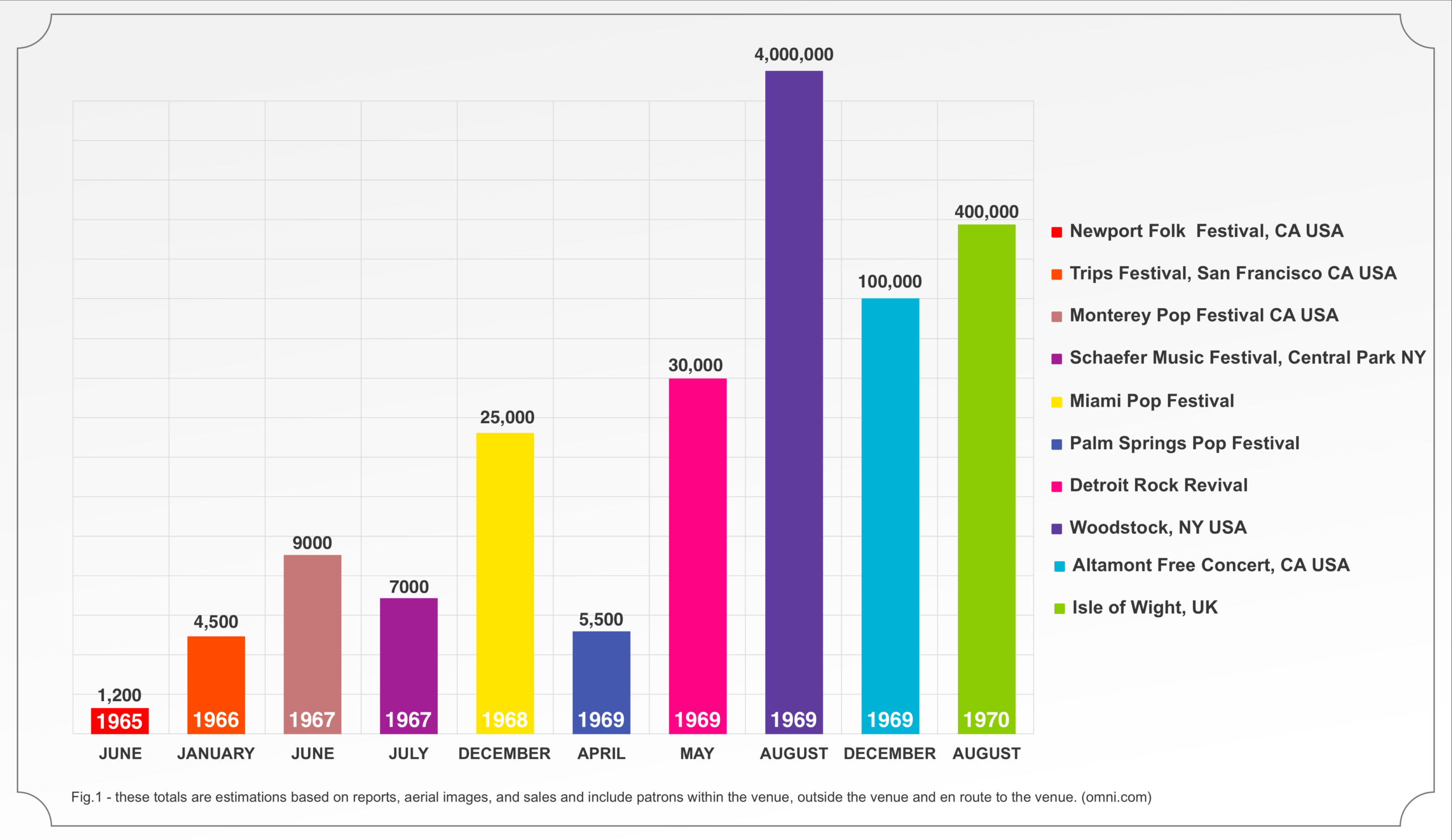
This graph was created by compiling attendance estimates from a wide range of historical sources cited in the Works Cited, including newspaper accounts, radio reports, festival announcements, eyewitness reports, aerial-image estimates, ticket-sales references, chroniclers of the 1960s music scene, documentary sources, and later historical summaries of major rock and folk festivals. The purpose of the graph is not simply to list festival sizes, but to place Woodstock 1969 in visual context beside other comparable music gatherings from the same cultural period. The figures include reported attendance inside the venues, people gathered outside the official festival grounds, and, where available, estimates of those traveling toward or surrounding the event area. When viewed alongside festivals such as Newport Folk Festival, Monterey Pop, Miami Pop, Detroit Rock Revival, Altamont, and Isle of Wight, Woodstock appears not as an isolated concert, but as the extraordinary tipping point of a growing youth-music movement. The chart shows how festival attendance expanded rapidly between 1965 and 1970, with Woodstock standing dramatically apart in scale, symbolism, and cultural impact. By comparing these events side by side, the graph helps demonstrate why Woodstock became more than a music festival: it became a mass gathering, a pilgrimage, and a defining public image of the Aquarian counterculture. The attendance data used for the chart identifies Woodstock at 4,000,000 when including patrons within the venue, outside the venue, and en route to the festival, making the visual comparison especially useful for understanding the size of the moment in relation to other landmark festivals of the era.
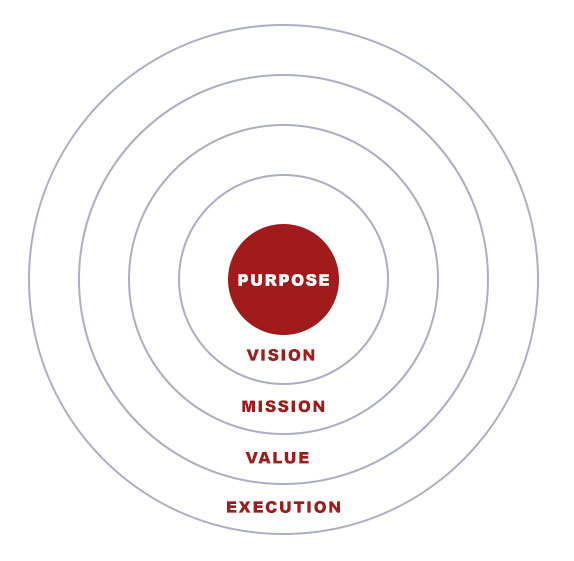
This chart helps explain how Woodstock ’69 reached the tipping point by showing how a powerful movement begins at the center and expands outward. At the core is purpose: the deep reason people gathered, which for Woodstock was more than music. It was the desire for peace, freedom, community, and a different way of living during a time of war, social unrest, and generational change. From that purpose grew a vision: the dream of a massive, peaceful gathering built around music, love, and shared ideals. The mission became the practical act of creating the festival itself, bringing together musicians, organizers, young people, travelers, and countercultural voices in one place. The values radiated outward through the crowd: cooperation, tolerance, nonviolence, creativity, and communal care. Finally, execution represents the real-world event—the roads, the stage, the rain, the food shortages, the crowds, the music, and the astonishing fact that hundreds of thousands of people gathered with very little violence. In this way, the chart shows how Woodstock did not become iconic by accident. Its purpose, vision, mission, values, and execution aligned at exactly the right cultural moment, allowing the festival to move beyond being a concert and become the visible tipping point of the 1960s youth and peace movement.
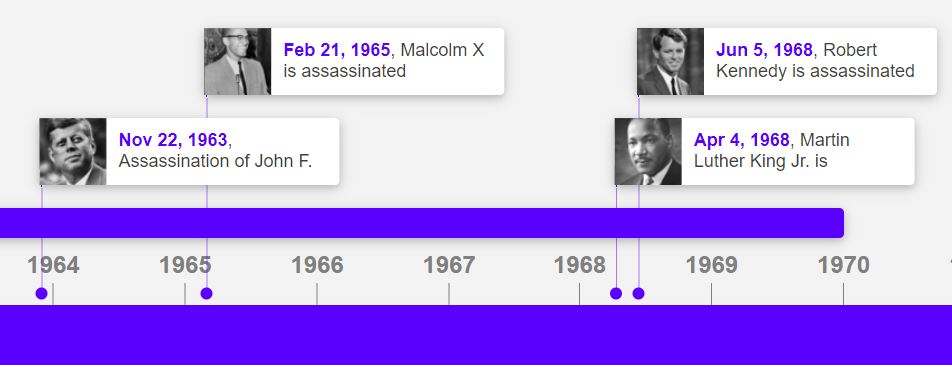
This timeline graph helps explain why the 1960s youth and peace movement did not appear suddenly, and why Woodstock ’69 became more than a music festival. The graph marks a series of national traumas: the assassination of President John F. Kennedy in 1963, Malcolm X in 1965, Martin Luther King Jr. in April 1968, and Robert Kennedy in June 1968. For young people coming of age during these years, these events created a repeated emotional shock. Each assassination seemed to remove another figure associated with hope, justice, civil rights, public service, or social change. At the same time, the Vietnam War, the draft, racial violence, generational conflict, and distrust of government were intensifying. The result was a growing sense among young people that the old systems had failed them.
This is where the idea of pilgrimage becomes important. In this context, pilgrimage does not mean only a religious journey. It means a meaningful journey toward a place that seems to hold spiritual, emotional, or cultural significance. By 1969, many young people were not simply going to hear bands play. They were traveling toward Woodstock as if they were traveling toward proof that another kind of world was possible. The journey itself became part of the meaning: hitchhiking, walking, driving through traffic, sleeping in fields, sharing food, enduring rain, and joining strangers in a shared act of peace.
The graph shows the pressure building year after year. These assassinations became part of the emotional landscape that pushed the youth movement toward a tipping point. Woodstock became that tipping point because it gathered grief, resistance, music, idealism, and longing into one visible event. What began as a concert became a symbolic destination. For many, Woodstock was a pilgrimage toward peace, community, and hope after years of violence, loss, and disillusionment.
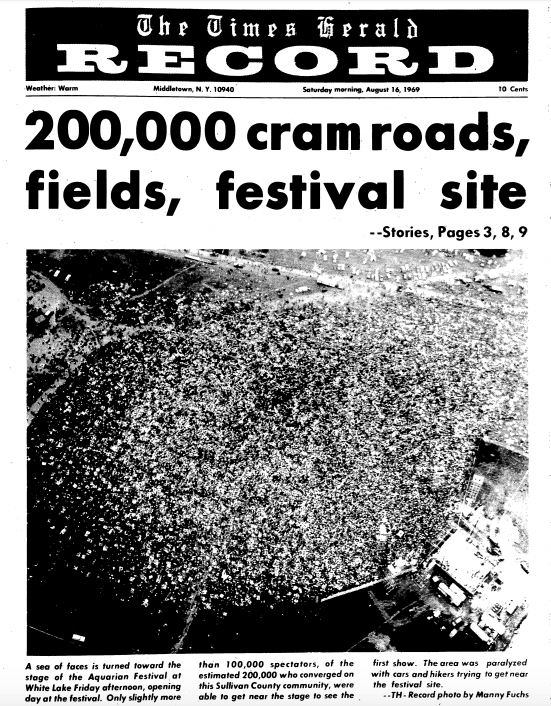
This newspaper image is important because it captures only one measurable moment from one visible vantage point, not the full human scale of Woodstock ’69. The headline, “200,000 cram roads, fields, festival site,” describes the number of people that could be seen or estimated in the immediate area: the festival grounds, the nearby fields, and the roads visible around the site at that time. In other words, this figure reflects the crowd that had already arrived or could be observed from the aerial view and local reporting position. It does not include the full number of people attempting to reach Woodstock, including those trapped in traffic for miles, walking along roads, sleeping in cars, turning back, arriving later, or moving toward the concert in what became a pilgrimage-like journey. This distinction matters because Woodstock was not contained neatly inside a ticketed venue. The festival expanded outward into the highways, hillsides, farms, and surrounding communities. The image shows a “sea of faces,” but it is still only a partial view of a much larger movement in motion. For this reason, the article helps support the idea that Woodstock’s attendance cannot be understood only by counting people near the stage. The full meaning of Woodstock includes the thousands upon thousands of young people traveling toward the site, drawn by music, peace, community, and the hope of witnessing something larger than an ordinary concert.
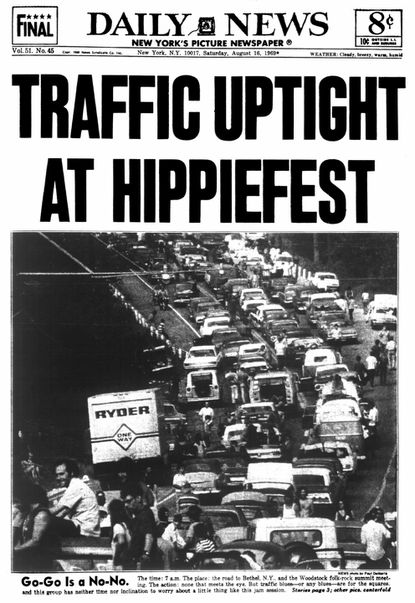
This newspaper image represents one visual fragment of the larger traffic evidence used to understand Woodstock ’69 attendance. The headline “Traffic Uptight at Hippiefest” shows the roads, highways, and local access routes overwhelmed by people moving toward Bethel, New York. The traffic pattern included the New York State Thruway, Route 17, Route 17B, the White Lake roads, the Bethel access roads, and the smaller rural roads leading toward Max Yasgur’s farm. Beyond New York, festivalgoers also traveled from New Jersey, New England, the Midwest, Canada, and other parts of the country, turning the road system itself into part of the event. This image is therefore not a complete count of Woodstock attendance, but a pictorial representation of the broader numbers reflected in the comparative graph: people were not only inside the festival grounds, but also stalled on highways, walking from abandoned cars, moving through fields, waiting on roads, and still attempting to arrive. In that sense, Woodstock’s attendance cannot be measured only by the crowd in front of the stage. The “pilgrimage” included those already gathered, those surrounding the site, those trapped in traffic, those redirected by closed or blocked roads, and those still making their way toward what had become a symbolic destination of peace, music, and generational belonging.